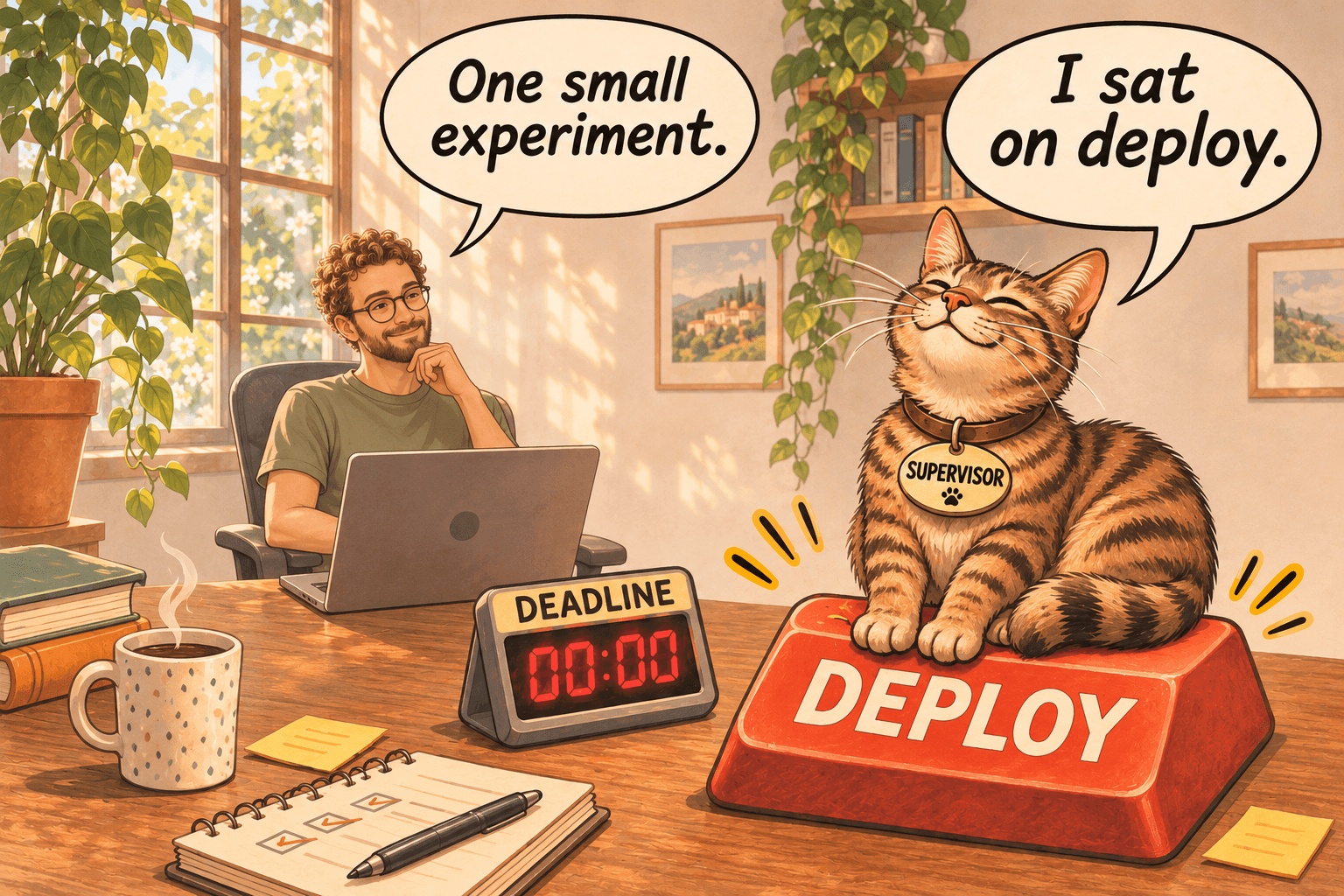
The deadline is Friday. The calendar is full. Someone has an idea that could make the product better, and the obvious response is: after the launch. Sometimes that is the right call. But if every new idea has to wait for a quiet week, very few will get a fair hearing.
Innovation sounds expensive when it means starting over. Under a tight deadline, it helps to give it a smaller job: answer one question that could improve what you are already trying to deliver.
Choose the uncertainty that matters.
Imagine a team preparing a new signup flow. The original plan asks people to complete a long form before they can see the product. Someone suggests letting them try a sample first.
Building both versions would put the deadline at risk. A rough prototype of the sample experience might be enough to learn whether people understand the offer more easily. The useful question is specific: does seeing an example help someone decide whether to sign up?
That question gives the experiment a purpose. It also makes it easier to set aside unrelated ideas, even good ones, until there is time to examine them properly.
Give the experiment an end.
Before starting, decide how much time you can spend, what you need to learn, and what you will do if the result is unclear. For the signup example, that might mean an afternoon making a clickable prototype and a few short sessions with potential users.
A handful of conversations will not prove that conversion will improve. They can reveal whether the idea is confusing, whether an important step is missing, or whether it deserves a more careful test later.
A useful experiment ends with a decision, even when the decision is to keep the current plan.
Keep the existing approach available. When an experiment has no affordable way to stop, it can quietly become a second project.
Make space by removing something.
An experiment still takes time. Adding it to an already full schedule and expecting everyone to work later is a poor way to make room for creativity.
Look at the scope with the people responsible for delivery. Could a secondary screen wait? Could a meeting become a short written update? Could a decorative detail move to the next release? Agree on the tradeoff before the experiment begins.
Keep the time needed for testing, accessibility, and fixing problems. A promising idea still has to work for the people who will use it.
Leave time to turn the idea into finished work.
A prototype can be convincing long before it is ready to ship. If the experiment succeeds, there is still implementation, review, and verification to do. Set the decision point early enough to allow for that work.
If there is no longer enough time, record what you learned and give the idea a concrete next step after launch. A short note with the question, the observations, and the remaining uncertainty is much more useful than a forgotten task called “improve onboarding.”
Some deadlines genuinely leave no room for exploration. Say so, and revisit the schedule if that becomes the permanent condition. For the projects with a little flexibility, protect one small experiment. Ask a useful question, stop at the agreed time, and use the answer to decide what deserves to ship.